When people hear CDM Regulations, they often assume they only apply to large commercial construction projects. In practice, CDM 2015 applies to all construction work, including domestic projects. If you are planning building work on your home, it is important to understand how CDM 2015 applies to domestic clients and how responsibilities are managed in practice to ensure work is carried out safely and legally.
What Is a Domestic Client?
Under the Construction (Design and Management) Regulations 2015, a domestic client is:
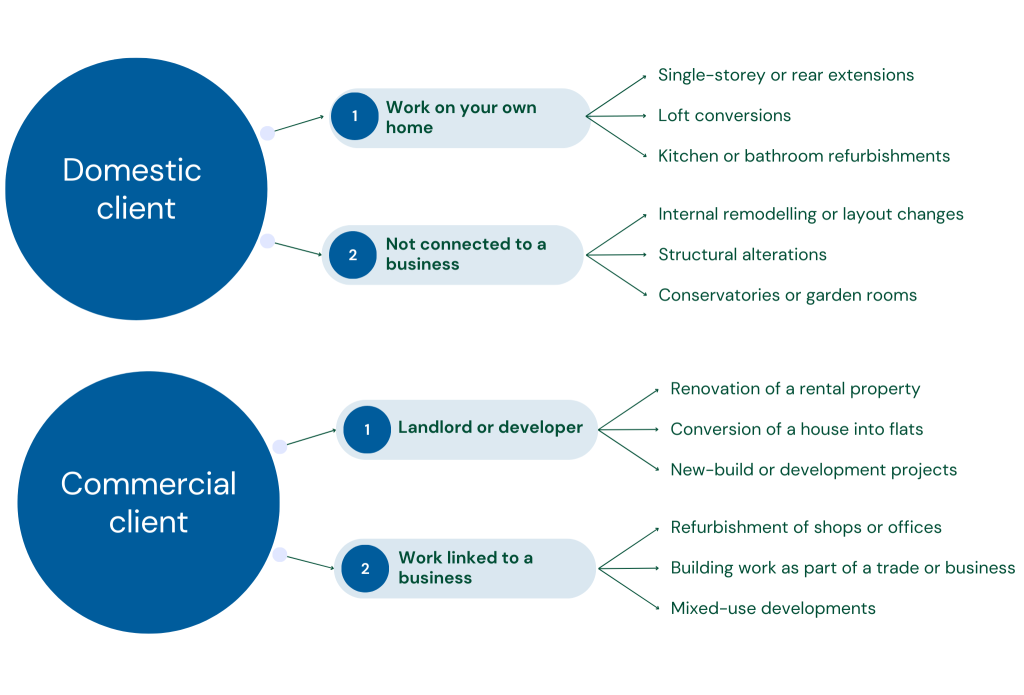
An individual who has construction work carried out on their own home, or the home of a family member, where the work is not connected to a business.
If the work is connected to a business, for example, if you are a landlord or developer, you are classed as a commercial client, and different duties apply.
Does CDM 2015 Apply to Domestic Projects?
Yes. CDM 2015 applies to all construction work, regardless of size, duration, or whether the client is domestic or commercial.
The key difference lies in how the regulations manage client duties.
Do Domestic Clients Have Legal Duties?
Yes, but most duties are automatically passed to others.
The regulations recognise that most domestic clients have little or no construction knowledge and are not experienced in managing health and safety.
As a result, CDM 2015 places the client duties with professionals already involved in the project.
Domestic vs Commercial Clients – Key Difference
For clarity, CDM 2015 clearly distinguishes between:
Domestic clients – duties are normally passed to others
Commercial clients – full client duties remain with the client
If you are commissioning work as part of a trade or business, you may have additional legal responsibilities, and the project may be notifiable.
Who Takes on the Domestic Client Duties?
Single Contractor Project
If only one contractor is involved:
The contractor takes on the domestic client duties automatically
Multiple Contractor Project
If more than one contractor is involved:
The Principal Contractor takes on the client duties
OR, the domestic client can agree in writing for a designer (e.g. architect) to take on the role
If a designer accepts this responsibility in writing, they also become the Principal Designer.
If there is no written agreement, the duties default to the Principal Contractor.
Do Domestic Clients Need Construction Knowledge?
No. A domestic client does not need to have technical construction knowledge, specialist health and safety expertise, or prior experience managing construction projects.
However, domestic clients still play an important role by making reasonable checks on competence, asking simple questions about health and safety, and allowing enough time and budget for work to be carried out safely.
This helps ensure the people you appoint are capable of managing risks properly.
What Work Is Notifiable to the HSE?
In certain circumstances, duty holders must notify the HSE if construction work:
Lasts longer than 30 working days and has more than 20 workers on site at the same time, or
Exceeds 500 person-days of construction work
The Principal Contractor (or Principal Designer, depending on appointment) is responsible for notifying the HSE.
Key Responsibilities Associated with Domestic Client Projects
Although client duties are transferred, domestic projects must still ensure:
Appointment of a Principal Designer (where required)
Appointment of a Principal Contractor
Competency checks on appointed professionals
Compliance with Building Regulations
Proper coordination and communication between duty holders
Ongoing review of arrangements throughout the project
Appointed professionals manage these responsibilities on the domestic client’s behalf.
Why This Matters
CDM 2015 exists to reduce accidents and ill health, protect workers, homeowners, and members of the public, and ensure that construction work is properly planned, managed, and carried out safely. Even on small domestic projects, a lack of planning, poor coordination, or the appointment of unsuitable contractors can lead to serious risks, injuries, or long-term health issues.
Find out more
Further guidance on domestic clients and CDM 2015 is available from the Health and Safety Executive (HSE). Homeowners and duty holders can find detailed, up-to-date guidance on domestic client responsibilities on the HSE website.
Need Support with CDM on Domestic Projects?
We support domestic and low-risk construction projects by providing clear, proportionate CDM advice and and Principal Designer services. Our aim is to make compliance straightforward while keeping people safe.
✔ Construction Phase Plans
✔ Risk Assessments & Method Statements
✔ Pre-Construction Information
✔ Site Audits
✔ Health & Safety Files
✔ Construction Management Plans
✔ NEW Principal Designer
(BSA Regulations) Services Available
More from the Saftey CDM team...
-

CDM 2015: Do Domestic Projects Need to Comply?
January 15, 2026 Building -
How to Shut Down Your Construction Site Safely Over Christmas
December 8, 2025 Building